Text
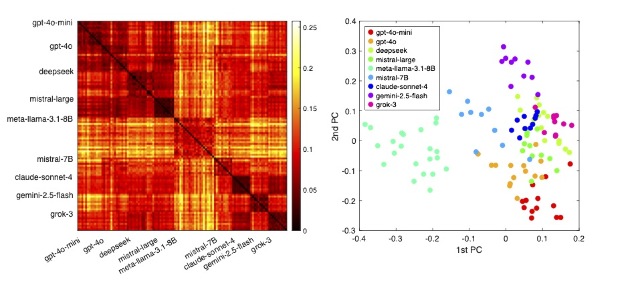
Jahrmann M, Brandstetter T, Glasauer S (2025). ROBOPSY PL[AI]: Using Role-Play to Investigate how LLMs Present Collective Memory. arXiv https://doi.org/10.48550/arXiv.2510.09874 The paper presents the first results of an artistic research project investigating how Large Language Models (LLMs) curate and present collective memory. In a public installation exhibited during two months in Vienna in 2025, visitors could interact with five different LLMs (ChatGPT with GPT 4o and GPT 4o mini, Mistral Large, DeepSeek-Chat, and a locally run Llama 3.1 model), which were instructed to act as narrators, implementing a role-playing game revolving around the murder of Austrian philosopher Moritz Schlick in 1936. Results of the investigation include protocols of LLM-user interactions during the game and qualitative conversations after the play experience to get insight into the players' reactions to the game. In a quantitative analysis 115 introductory texts for role-playing generated by the LLMs were examined by different methods of natural language processing, including semantic similarity and sentiment analysis. While the qualitative player feedback allowed to distinguish three distinct types of users, the quantitative text analysis showed significant differences between how the different LLMs presented the historical content. Our study thus adds to ongoing efforts to analyse LLM performance, but also suggests a way of how these efforts can be disseminated in a playful way to a general audience. Comments: 17 pages, 4 figures Subjects: Human-Computer Interaction (cs.HC); Artificial Intelligence (cs.AI); Computers and Society (cs.CY) Cite as: arXiv:2510.09874 [cs.HC] (or arXiv:2510.09874v1 [cs.HC] for this version) https://doi.org/10.48550/arXiv.2510.09874