Text
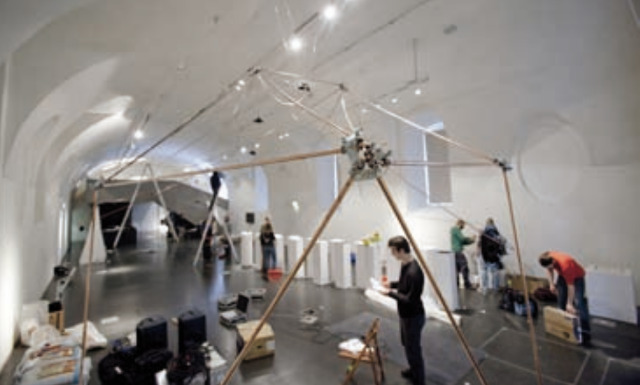
Universe Architecture Remarks on the exhibition architecture The Digital Art Department is concerned with the exploration of robotics, interaction, programming codes, images, sound and time-based art, amongst other topics. In order to demonstrate this diversity in an exhibition, a group of digital art students developed a solution, aimed at reducing the amount of individual exhibition space, whereby the auratic quality of an original work was forfeited so that a a number of differing projects could be presented simultaneously. The loss of the auratic was to be replaced by the stage management of the entire exhibition area. Each piece of work received a 30 x 30 x 30 cm area of space. A physical item was to be created for display within this space, as a reference to the original. This was to be seen as a model in an architectural sense, not as a scaled down replica, but as a new creation, a custodian, which through its own autonomy, would point to the original – a computer world alias seen as a body within a geographic space. The design concept of the exhibition attempts to establish movement, interactive projections and intersecting lines of sound as elements within architectonic thinking. The aliases are found on mobile columns which can be moved by the recipients. The columns also serve as an interface that triggers and activates the entire room installation. They are recognised by the software in a project-oriented way and image projections, sound lines and robotic events that create and expand the exhibition architecture are activated. A total of three projections and an eight-channel sound system are available for each project. Thus the reference pointer which initially exists as a body within a geographical dimension, is extended to spectromorphological and pictorial spaces. The expansion of the project idea from a body into the architectural space of the exhibition not only serves as further elucidation of the individual projects but also means that, since two columns can trigger their extension simultaneously, due to the fact that the entire playing system exists in twin form, aleatory overlaps between initially individual works are created. The recipients can mix the works like samples with the result that a “universe architecture” is created, in the sense of the “Universe Symphony” by Charles Ives, in which the recipients are able to playfully blend differing image and sound sources to form new architectonic compositions.