Text
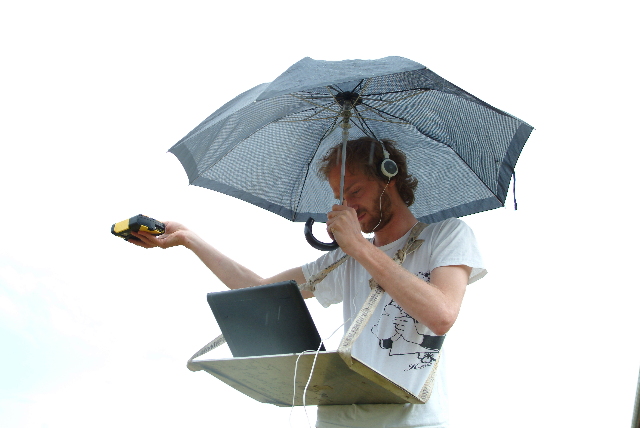
2008, MMW Festival, Wien (AT) What architectural form emerges when the geometric body of real space takes on effects of the temporal corporeal and ephemeral, or, asked the other way around, when time-based processes are located? Transit is a research project situated between the Internet, which is suspected of dissolving space, and the geospatial network, which is again located in architectural space. The possibility of geometric location of digital data in public spaces leads to process-based non-visible and intangible physicalities in geometric structures. These physicalities have parallels to earlier, spatially topologically defined time-based elements, such as the placement of cicadas in the garden architecture of the Chinese Shang Dynasty. On an open space in front of the Kleylehof (Burgenland/Austria) the colonization of the geospatial network is exemplarily carried out to investigate its sculptural qualities. A virtual grid with the dimensions 1m x 1m x 1m is created in three superimposed levels. The settlers (artists) are equipped with mobile input devices, by means of which they can deposit the four different types of "building materials" (video, sound and text-based media data and program code) in the grid blocks, which can be located by DGPS. Each settler is given the opportunity to settle 8 blocks of his or her own choice. Furthermore, 20 % of the settable space is made available for common use and an open space share of approx. 60 % is aimed for. The blocks have entrances and exits, whereby they can be interconnected (also blocks of different persons, if they release their data channels), thereby creating a media-based network with locatable nodes (in Euclidean space).