Inhabiting the Void
- Rethinking Archives and Exhibition Online
Lecturer
Date
- 27 October 2025–29 October 2025 Naples, NA, Italy
Keywords
Archive, Digital Archives, Internet, Digital Art, 3D Print, 3D Technology, Augmented Reality (AR), XR, Media Theory, Digital Environments, Digital Exhibition, Spatiality in Digital Space, Embodied Engagement , Dimensional Infrastructures, Ecological Engagement, Platform Critique, Media Theory, Digital Spatial Practice, Artistic Research , Critical Interface Design, Reciprocity, Slowness, Participatory Infrastructures, Critical Digital Culture
Text
Despite the proliferation of online exhibitions and archives, many still reproduce flat, two-dimensional display models that undermine spatial understanding and embodied engagement. This paper argues for another way—for digital spaces that hold contradiction, invite pause, and remember the body. It asks the question: How can digital environments become dimensional infrastructures of care rather than flat repositories of content? Drawing on media theory and artistic practice, it develops a theoretical-conceptual framework for inhabiting digital space through depth, reciprocity, and refusal. The paper uses close readings of selected artworks—Danielewski’s House of Leaves (2000), Baker Cahill’s Substrate (2024–2025), Allahyari’s Dark Matter (2014), and Troika’s Grenzgänger (2024)—and engages the work of Chun, Hayles, and Rushkoff to identify three modes of critical engagement. These are dimensional infrastructures (interfaces that cultivate spatial depth and embodied navigation), ecological models of engagement (reciprocal, co-creative relations), and cracks in the system(methodological ruptures that reveal and reconfigure platform logics). The paper argues that digital environments are materially and ideologically structured, and that meaningful engagement requires friction, reciprocity, and the possibility of refusal. The paper concludes with actionable heuristics for curators and educators—design for slowness, make protocols legible, enable refusals, and treat digital archives as situated, reconfigurable public spaces. Reframing digital distribution as inhabitation rather than dissemination, the paper offers criteria for constructing participatory, critically literate online environments where technology becomes a space of relation, resistance, and shared world making.
Title of Event
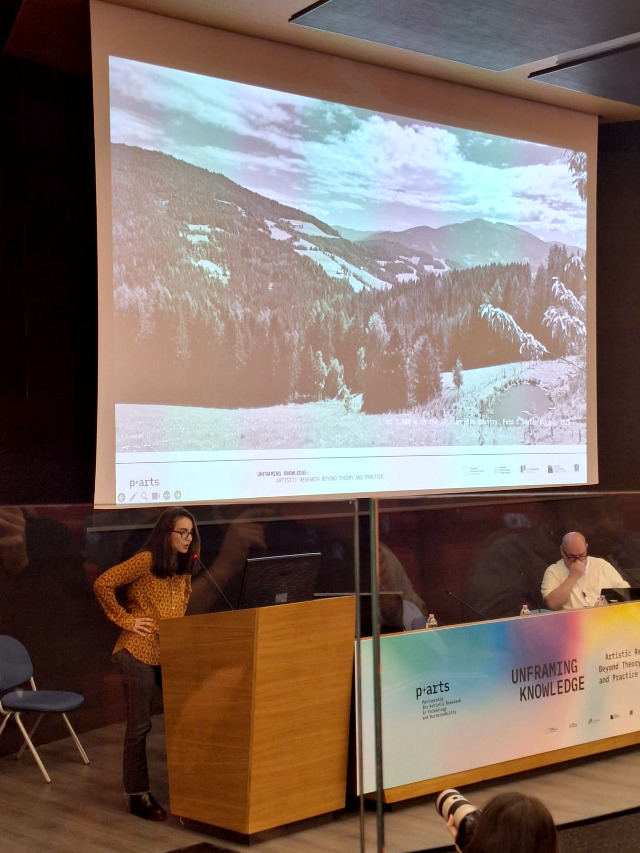
P+ARTS Conference - Unframing Knowledge: Artistic Research Beyond Theory and Practice
Organiser/Management
Location
Address
- Naples, NA, Italy
- Naples
- Italy
Associated Media Files
 Image#1