Abstract
Plastics, perhaps more than other materials, are associated with the economic boom after the Second World War. In 1957, Roland Barthes expressed his “constant astonishment” at this new material in The Myths of Everyday Life, pointing out that “for the first time […] the artificial aims at the ordinary.” For the mass market, plastic served as a material that promised unlimited applications and enabled innovation. Barthes’ encounter with the material took place at a fair aimed at potential consumers. Plastic was already part of a consumer vision and thus an idea of the future. Plastic and consumption became synonymous. Despite Barthes’ astonishment at an “ideal machine”, the production conditions were still far from standardised. Many consumer goods such as air mattresses, mackintoshes, balls etc. were produced by hand – which opened up business opportunities for small and medium-sized enterprises in particular.
The paper focusses on Austrian family businesses whose foundation dates back to the years after 1945. It shows that the small-structured businesses were all the more dependent on existing networks because, in contrast to industry, they were hardly able to provide resources for research and development. There was a lively exchange between the entrepreneurs, schools (such as the Technologisches Gewerbemuseum in Vienna) and universities (such as the Montanuniversität in Leoben).
* * *
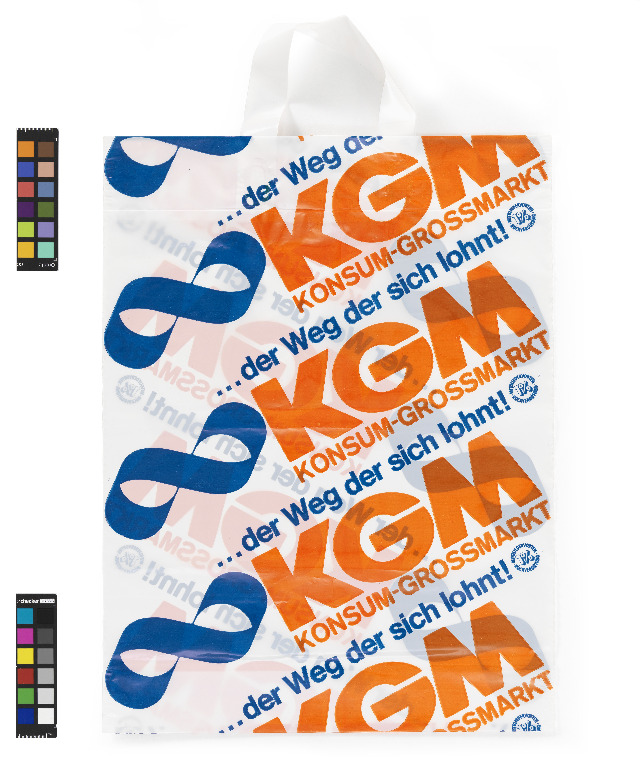
Caption: Plastic bag, “KGM Konsum-Großmarkt”, ca. 1975–1985, Wien Museum Inv.-Nr. 309043/15
Titel der Veranstaltung
The International Congress of History of Science and Technology
Veranstalter*innen
International Committee for the History of Technology
,
Division for the History of Science and Technology
,
International Union of the History and Philosophy of Science. International Cooperation in History of Technology Committee